Poinsettias get the panic, lilies do the damage: what cat owners search for at Christmas, and what actually puts cats at risk
Part of: Toxic plants for cats · Foods toxic to cats · Christmas cat safety
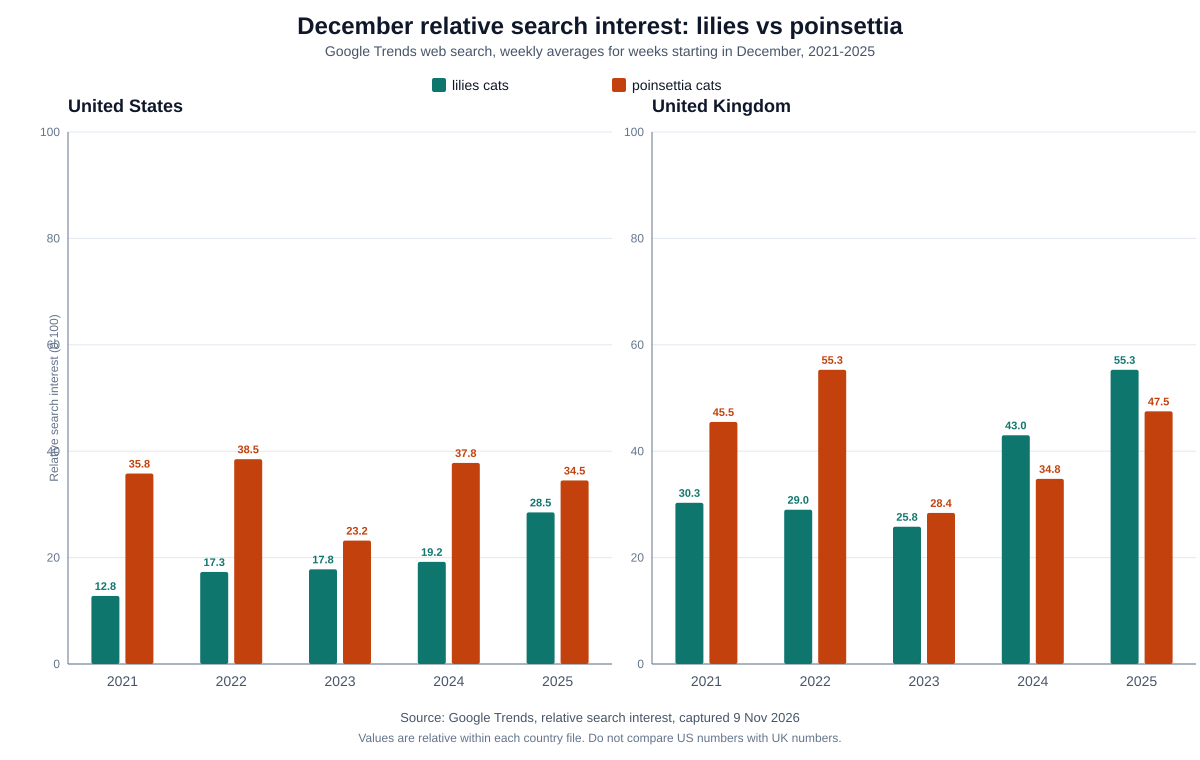
Every December, cat owners type the same worry into a search box: is that red plant going to kill the cat? Google Trends cannot tell you how many people searched, and it cannot rank toxins. It can show relative search interest in a handful of plain terms, in the US and the UK, from November 2021 to November 2026. The pattern is consistent enough to write down. Poinsettias get the seasonal panic. Lilies keep the search interest for the rest of the year, and they are the plant that actually causes acute kidney failure.
Source: Google Trends, relative search interest, captured 9 Nov 2026.
Values are relative within each country file. Do not compare US numbers with UK numbers.
What the searches show
The clean comparison is Set B: the terms 'lilies cats' and 'poinsettia cats' (plus three quieter festive terms) in the same file, for the United States and, separately, the United Kingdom. In the US file, average December relative interest in 'poinsettia cats' was higher than in 'lilies cats' in every year from 2021 to 2025 (35.8/38.5/23.2/37.8/34.5 against 12.8/17.3/17.8/19.2/28.5). That is a December spike, not a year-round lead. Outside December, average relative interest in 'poinsettia cats' in that same US file was 2.4, close to zero, while 'lilies cats' stayed at 33.0.
Lilies dominate the rest of the year in both files and rise around Easter. Average relative interest in 'lilies cats' for weeks starting in March or April ran from 40.3 to 49.9 in the US file and from 52.0 to 61.1 in the UK file (2022 to 2026). Those two ranges come from two different files. Do not treat them as a US-versus-UK comparison of the raw numbers. They are the Easter-shaped peak inside each series.
The UK file tells a slightly different December story, and it is worth saying plainly. 'Poinsettia cats' led 'lilies cats' in December 2021, 2022 and 2023 (45.5/55.3/28.4/34.8/47.5 against 30.3/29.0/25.8/43.0/55.3). In December 2024 and 2025, 'lilies cats' overtook it (43.0 and 55.3 against 34.8 and 47.5). Outside December, 'poinsettia cats' in the UK file averaged 1.9, again close to zero, while 'lilies cats' averaged 49.2.
The other Set B terms barely register. Average relative interest in 'raisins cats' was 1.7 in the US file and 0.9 in the UK file. 'Mince pie cat' averaged 0.0 and 0.0. 'Xylitol cat' averaged 0.7 and 0.3. A few weeks are not zero, but these series are not a useful Christmas-toxicity signal next to poinsettia and lilies. Search interest is also not risk. The clinic picture sits on the pages below.
What actually puts cats at risk
True lilies: the emergency
Only plants in Lilium and Hemerocallis are true lilies in the kidney-failure sense. The Merck Veterinary Manual is explicit: many plants have 'lily' in the name but are not true lilies and do not pose the same toxicity. True lilies damage renal tubular epithelial cells. Untreated, that toxicosis becomes acute kidney failure. There is no safe part. Petals, leaves, stems, pollen and vase water all count. A cat that brushes pollen onto its fur and grooms it off can become desperately ill. Treat every true-lily exposure as an emergency. Do not wait for vomiting to prove it. The dedicated pages are why lilies are so dangerous for cats and are lilies toxic to cats.
The ASPCA Animal Poison Control lists Easter lilies, Oriental lilies and Japanese lilies among Lilium species to watch, plus daylilies (Hemerocallis). Stargazer, Asiatic, tiger and similar florist lilies sit in the same emergency group on this site. Peace lilies and calla lilies are not true lilies. They still irritate the mouth. If you cannot name the stem, treat it as urgent until a vet or a clear photo says otherwise.
Poinsettia: milder than its reputation
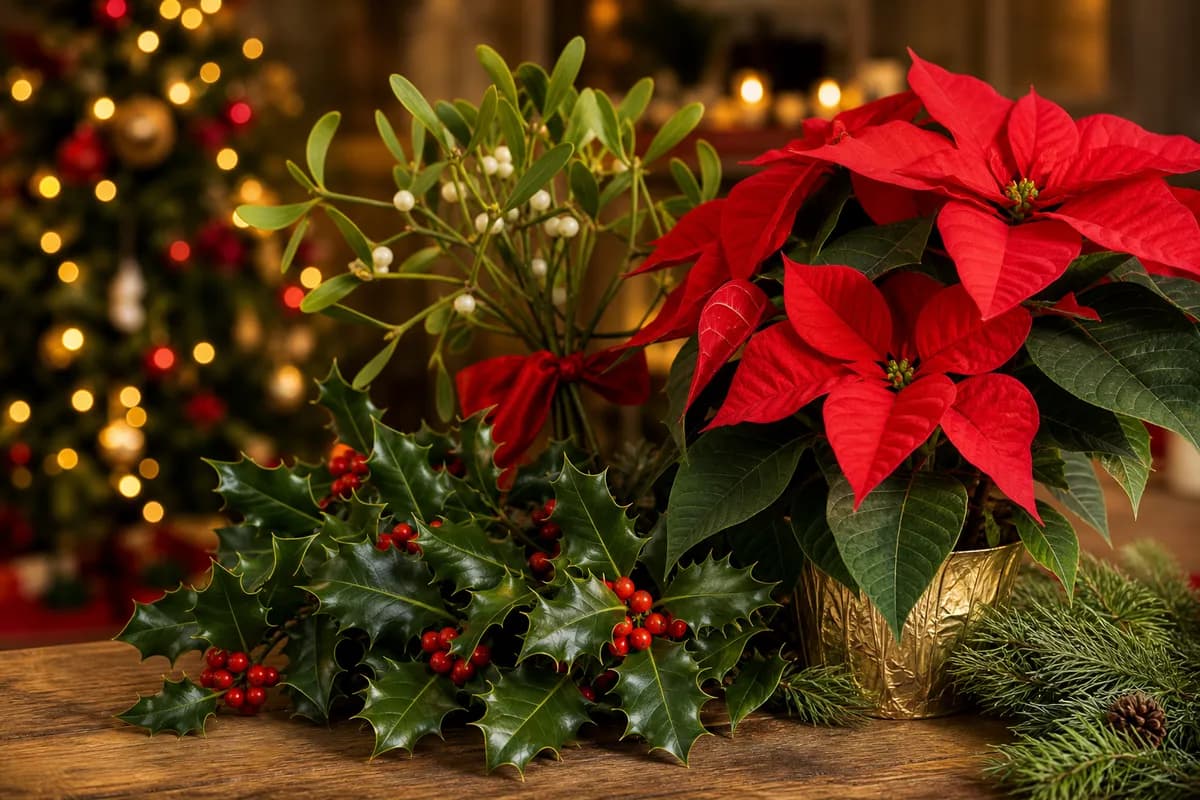
The ASPCA toxic and non-toxic plants list lists poinsettia (Euphorbia pulcherrima) as toxic to cats. The toxic principle is irritant sap. The signs are irritation of the mouth and stomach, sometimes vomiting, and the listing adds that toxicity is generally over-rated. Pet Poison Helpline calls poinsettia only mildly toxic to cats and dogs. After ingestion they list mild vomiting, drooling, or rarely diarrhoea. That is the whole myth in one line: the plant can upset a cat, and it is not the December killer of folklore. Full guide: are poinsettias toxic to cats? Myth vs reality.
The mix-up is the dangerous part. A red Christmas arrangement is not automatically a poinsettia. Florists tuck lilies into winter bouquets. If any trumpet-shaped lily was in the same pot, follow the lily pages, not the milder poinsettia picture.
Other festive risks, briefly
Chocolate, dried grapes and xylitol barely show up in these search terms. They still belong on a Christmas worktop check, because search interest is not a hazard list.
- Chocolate: poisonous to cats even in tiny amounts. Cats Protection says theobromine stays in the bloodstream and that you should call the vet straight away if any was eaten. Animal PoisonLine notes vomiting, hyperactivity and tremors first, and heart problems in more severe cases. Darker chocolate is the bigger load. See can cats eat chocolate and chocolate advent calendars.
- Raisins, grapes and mince pies: Animal PoisonLine treats grapes, raisins, sultanas and currants as a kidney concern and tells you to keep those bakes out of reach. Cats Protection says grapes, raisins and currants can cause kidney failure in cats. There is no known safe dose for grapes or raisins in cats in our grape guide. See grapes and raisins and Christmas dinner and your cat.
- Xylitol: a sugar alcohol in some sugar-free gum, sweets, peanut butters and toothpastes, also labelled birch sugar or E967. Published clinical evidence for cats is thinner than for dogs. That does not make it safe. Keep xylitol products away from cats, and treat known ingestion as an urgent veterinary question. See is xylitol toxic to cats.
If you think your cat was exposed
Call your vet or an emergency vet now if a true lily may have been involved. Do not wait for signs to appear, and do not try to make your cat sick unless a vet tells you to. Take the plant, packaging or a photo with you. In the UK, Animal PoisonLine on 01202 509000 is a 24-hour service run by the Veterinary Poisons Information Service. A fee applies per call.
How we measured this
The figures on this page are recomputed from Google Trends CSV exports kept in this site's repository (data/trends-2026-11/). Capture date: 9 November 2026. Time range: weekly web search from 7 November 2021 to 8 November 2026. Category: all categories. Query type: plain search terms, not Google Trends topics.
- Set B, the comparison we use: 'lilies cats', 'poinsettia cats', 'raisins cats', 'mince pie cat', 'xylitol cat'. One file for the United States, one for the United Kingdom.
- Relative, not a count: each file is scaled 0 to 100 within that file only. A 40 in the US file is not the same as a 40 in the UK file, and neither number is a search count. These figures are relative interest scores, not counts of searches.
- December and Easter windows: a week counts as December, or as March-April, when its start date falls in that month. US December 2021 to 2025 averages match the brief written from these CSVs to one decimal place.
- What we left out: Set A used 'poinsettia cat', 'lily cat', 'chocolate cat', 'christmas tree cat' and 'grapes cat'. We did not use those series as toxicity signals. 'Chocolate cat' and 'christmas tree cat' are noisy and ambiguous: they pick up chocolate-coloured cats and cats climbing trees. Set B's plural plant terms are the cleaner pair for lilies versus poinsettia.
The tidy December and March-April summary, plus the raw weekly Set B rows, is in the CSV download. A shareable PNG of the chart sits next to it. Both are free to reuse with a credit to Google Trends and Toxic Kitty.
Related guides
Frequently asked questions
- Does higher search interest mean poinsettia is more dangerous?
- No. These are relative search-interest figures, not risk rankings and not counts of searches. True lilies (Lilium and Hemerocallis) can cause acute kidney failure. Poinsettia is usually a milder irritant than its reputation suggests.
- Can I compare the US numbers with the UK numbers?
- No. Each Google Trends file is scaled 0 to 100 within that file only. A 40 in the US file is not the same as a 40 in the UK file.
- What should I do if my cat chewed a Christmas plant?
- Identify the plant if you can. If it may be a true lily, call your vet or an emergency vet now. In the UK, Animal PoisonLine on 01202 509000 can advise while you travel; a fee applies. Do not make your cat vomit unless a vet tells you to.
- Why ignore chocolate cat and christmas tree cat?
- Those Set A terms are noisy. They pick up chocolate-coloured cats and cats climbing trees, so we did not use them as toxicity signals. The lily versus poinsettia comparison uses Set B.
Sources
Authoritative organisations that cover this topic. These links open their public poison-control or toxicology pages, not a specific diagnosis for your cat.